

The most recent edition of the Business Monitor features business leaders’ views on Canada’s economic sovereignty. The Business Monitor is Canada’s only B2B omnibus.
The key highlights in this release include:
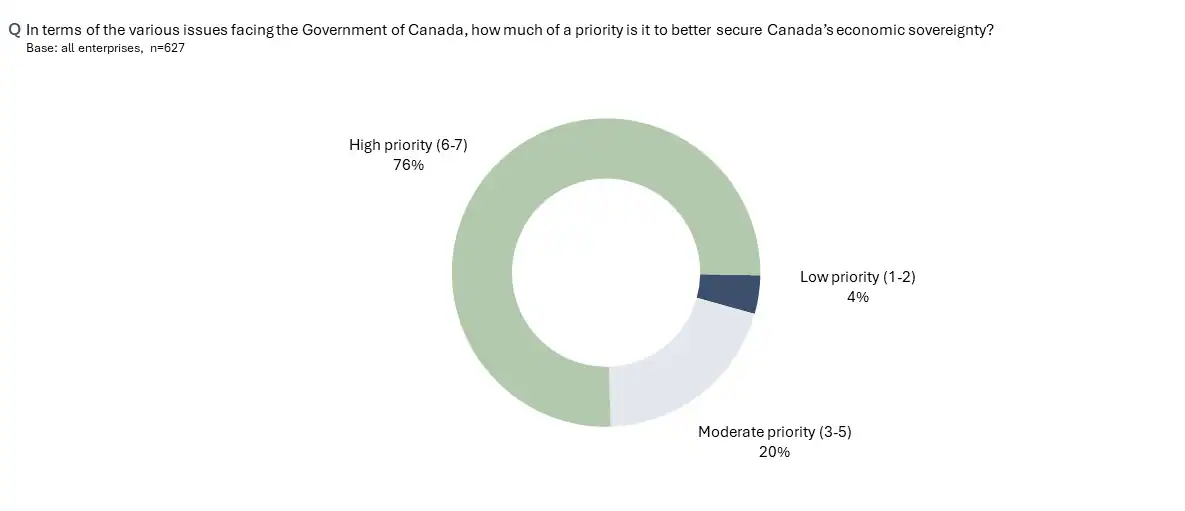
- Securing Canada's economic sovereignty is a high priority for a large majority business leaders.
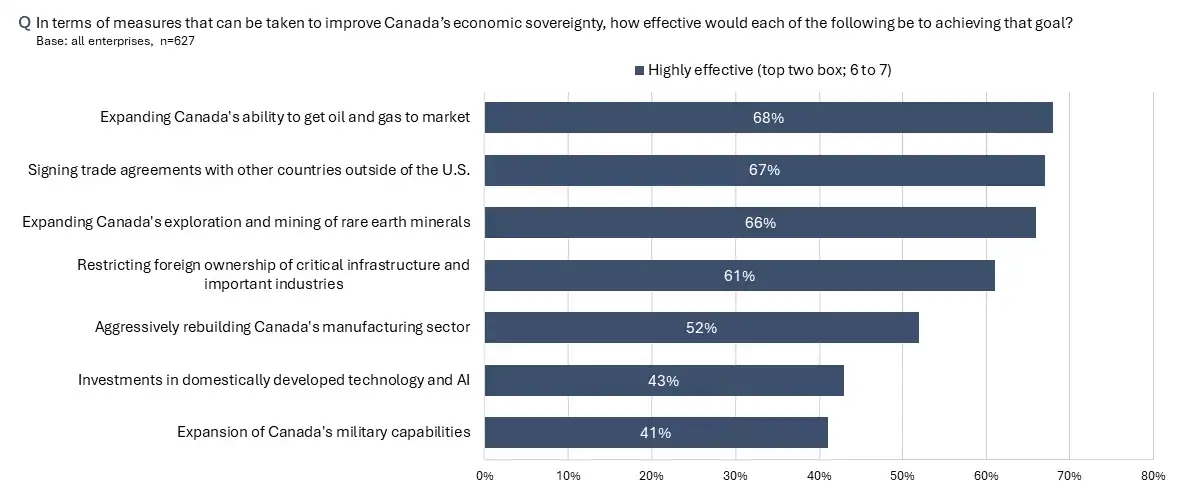
- Resource extraction and non-U.S. trade agreements seen as keys to improving economic sovereignty.
A more detailed presentation is in the report.
Three quarters of business leaders say securing Canada's economic sovereignty should be a high priority for the federal government.
Only a tiny minority say it is a low priority.
- These results are consistent across region, organizational size, and seniority.
Leveraging Canada’s natural resources and diversifying trade agreements are viewed as key measures that need to be taken to improve economic sovereignty.
Protection of critical infrastructure and industries is also widely viewed as highly effective for improving economic sovereignty. Relatively few point to domestic technology or the expansion of Canada’s military.
- These results vary regionally. For instance, expansion of resource extraction is seen as highly effective by a majority in all regions except Quebec.
Discussion
Since Trump’s election to a second term and overt threats to Canada, economic sovereignty has been a hot topic. It helped fuel Mark Carney’s election (‘elbows up!’) and, as such, is a core part of the current federal government’s mandate.
The issue clearly resonates with Canada’s business leaders. Less obvious is what they would like to see Ottawa do about economic sovereignty. Diversified trade agreements and resource extraction top the list. There is also strong support for restricting foreign ownership. It’s a back-to-basics approach with a touch of protectionism.

Methodology
The Business Monitor is powered by the Modus Business Panel – Canada’s only purpose-built, probability-based business panel.
The survey was conducted online using both email and SMS invitations/reminders, and completed via desktops, laptops, tablets and mobile devices. A total of 627 responses were gathered from Canadian managers and executives. As the Modus Business Panel is 100% recruited using RDD probability-based sampling, it is valid to cite the margin of error and to project these results to the broader population of business leaders with statistical confidence. The margin of error is plus or minus 3.9% at a 95% confidence interval. Sample matters.
The data have been weighted by enterprise size and region using the latest Canadian enterprise population data from Statistics Canada.