

Our latest release from the most recent Business Monitor – a quarterly tracking and B2B omnibus survey – shows broad concerns among Canadian business leaders about the economic impact of the war in Iran.
The key highlights in this release include:
- Overall concerns about the economic fallout of the war with Iran run high.
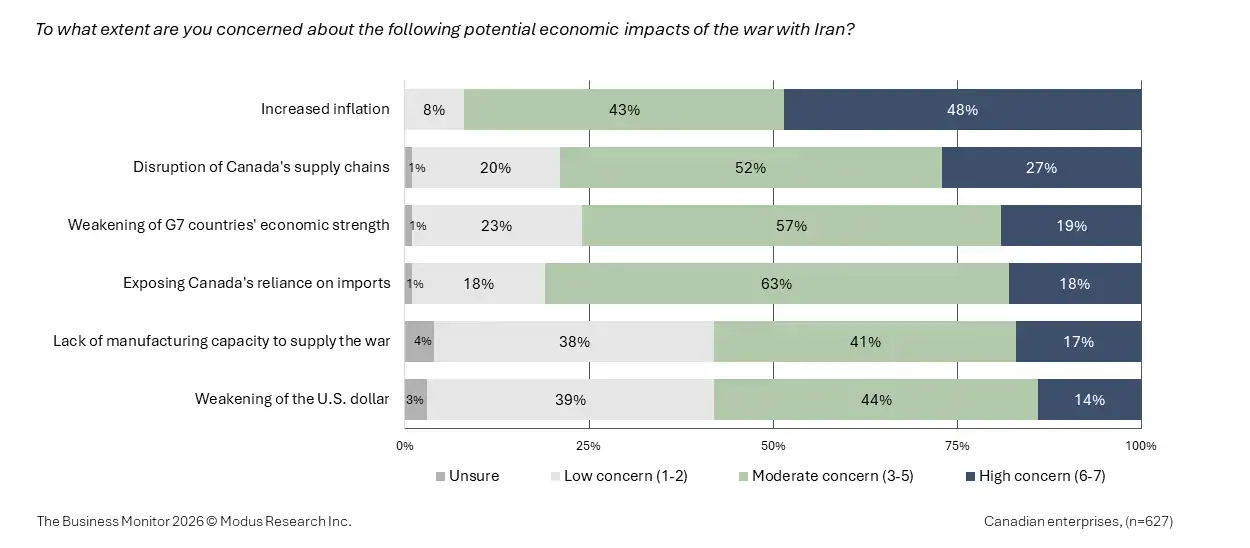
- Inflation is the greatest worry.
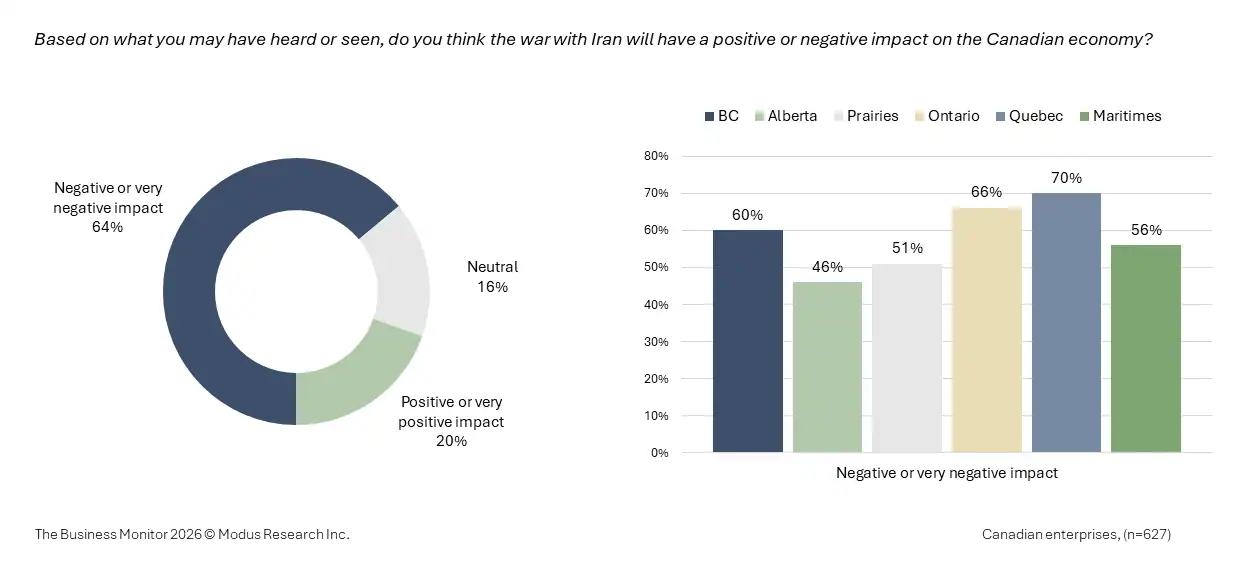
Large numbers of Canadian executives expect the war to negatively impact the Canadian economy.
A small but not insignificant minority foresee positive affects on the economy.
- Positive expectations run highest in the manufacturing sector (28%) and, curiously, the public sector (34%).
- In Ontario and Quebec negative expectations run two-thirds and higher.
Inflation is seen as the greatest of the potential negative economic impacts of war in Iran.
Supply chain disruptions, G7 economic weakening, and Canada’s reliance on imports also have large majorities expressing concerns.
Discussion
Shortly after the U.S. and Israel launched their February 28 attack on Iran, the Iranians responded by closing the Straight of Hormuz, creating a major choke point for maritime trade from the region. The disruptions to global trade have been significant.
Given the rapid impact of these disruptions, it is no surprise to find Canadian business leaders showing strong concerns about the negative impact on Canada’s economy. Certainly, a spike in the price of oil will have an inflationary affect. Boarder concerns about supply chain disruptions have yet to be felt and will depend on how far the situation escalates. The situation also has the potential to negatively impact Western hegemony in the region with potentially far-reaching consequences.

Methodology
The Business Monitor is powered by the Modus Business Panel – Canada’s only purpose-built, probability-based business panel.
The survey was conducted online using both email and SMS invitations/reminders, and completed via desktops, laptops, tablets and mobile devices.
A total of 627 responses were gathered from Canadian managers and executives between April 2 and 15, 2026 . As the Modus Business Panel is 100% recruited using RDD probability-based sampling, it is valid to cite the margin of error and to project these results to the broader population of business leaders with statistical confidence. The margin of error is plus or minus 3.9% at a 95% confidence interval.
The data have been weighted by enterprise size and region using the latest Canadian enterprise population data from Statistics Canada.