
The most recent edition of the Business Monitor features tracking support for increased trade diversification. The Business Monitor has been tracking this since early 2024 – well before Trump started threatening Canada with a trade war.
The key highlights in this release include:
- Suppport for increased trade diversification has dipped but remains strong.
- Fewer business leaders believe Canada is capable of diversifying.
- Large numbers continue to believe Canada is too dependent on U.S. economy.
A more detailed presentation is in the report, including data tables.
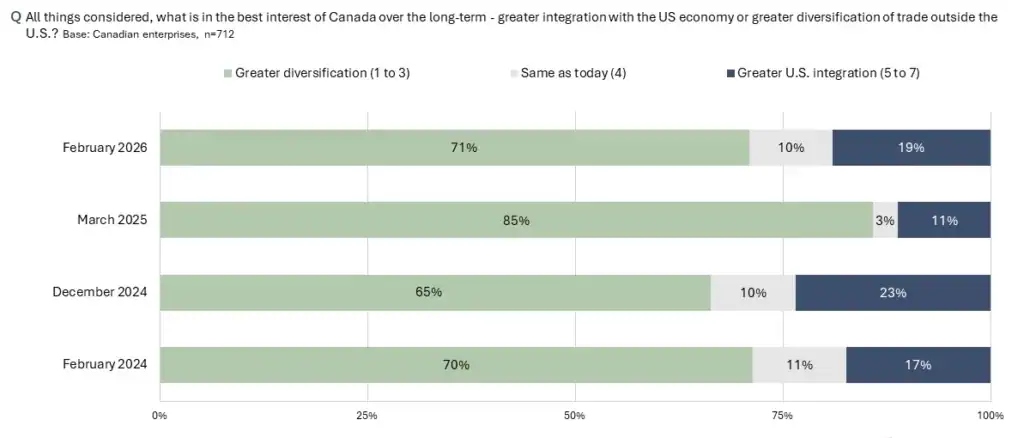
The number of Canadian businesses who want greater diversification of international trade has pulled back from last year’s high.
With the shock of Trump’s inauguration and his many threats to Canada at the time, the support for diversification peaked at over 4 in 5. While support for diversification remains high, it has pulled back as some business leaders recognize the difficulty of this path forward.
- This result varies across region and industry (please see report for data tables).
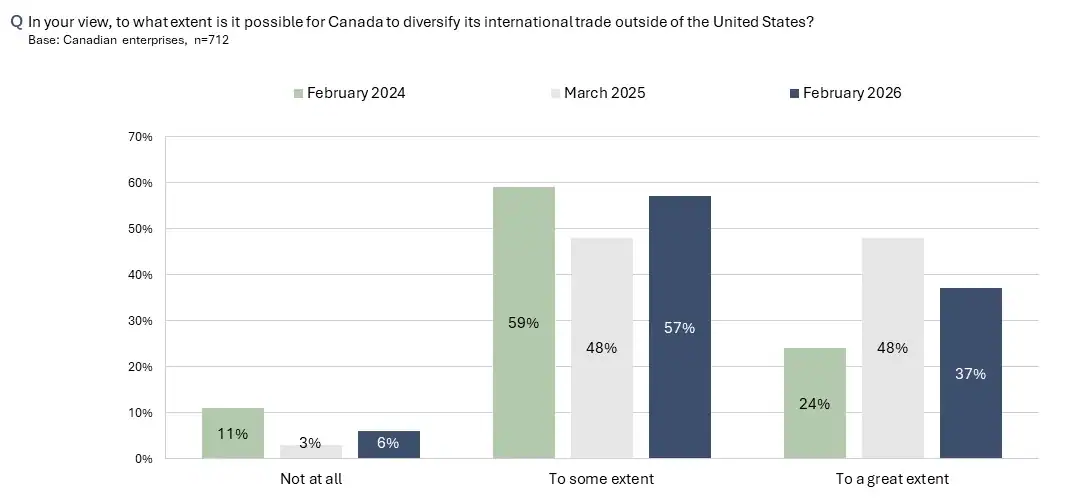
Reflecting the drop in support for diversified trade, significantly fewer business leaders see this as possible compared with 2025.
A year into Trump’s second term and plenty of focus on diversifying Canada’s international trade, it appears as though some business leaders have taken a more conservative view. Last year we reported on the massive support but a low level of preparedness for diversifying trade.
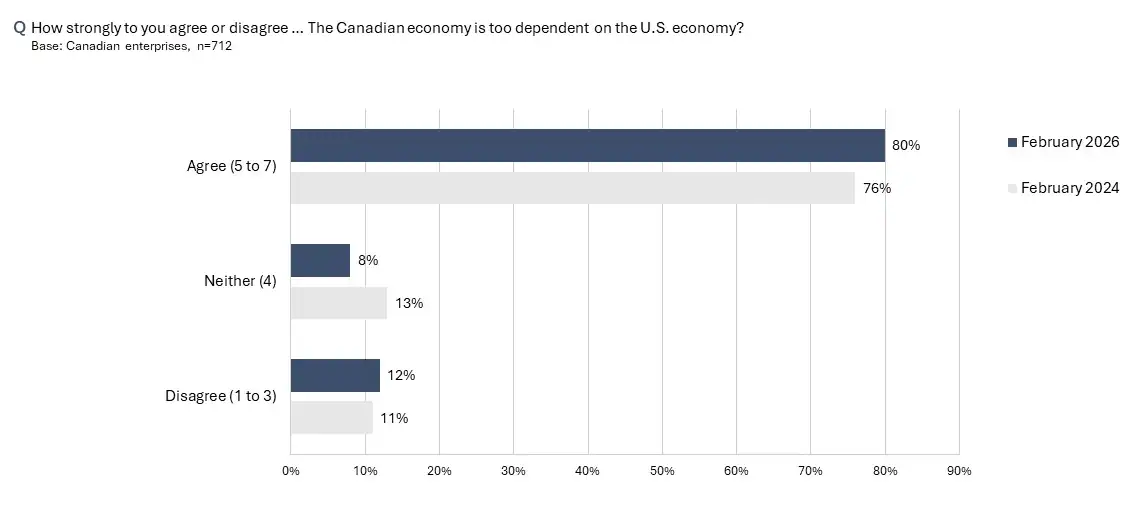
There is continued widespread agreement that Canada is too dependent on the U.S. economy.
First measured in early 2024, the perception that the Canadian economy is too dependent on the U.S. remains strong.
Discussion
After a year of Trump’s second term and with his focus shifted away from Canada since the start of hostilities with Iran this past summer, support for trade diversification outside the U.S. has abated somewhat. Certainly, Trump’s threats against Canada have waned over the past six months and last fall saw significant moves by both side at deescalating tensions. Canada recently announcing a trade deal with China provoked a threat of across-the-board 100% tariffs on Canadian exports to the U.S.. But generally, Trump’s focus has been elsewhere on the international scene.
The easing of support for increased trade diversification may simply be due some business leaders recognizing the challenges of diversifying Canada’s international trade. Certainly, there has been a notable drop in the number of business leaders who feel Canada is equipped for greater trade diversification.
This is not to overstate the importance of a 14-point swing in our tracking. A large majority continues to support increased diversification. Further, the perception that the Canadian economy is too dependent on the U.S. economy holds firm at fully 80 per cent.
The Business Monitor will continue to track this volatile situation over the coming months.

Methodology
The Business Monitor is powered by the Modus Business Panel – Canada’s only purpose-built, fully probability-based business research panel.
The survey was conducted online using both email and SMS invitations/reminders, and completed via desktops, laptops, tablets and mobile devices. A total of 712 responses were gathered from Canadian managers and executives. As Modus Business Panel is 100% recruited using RDD probability-based telephone sampling, it is statistically valid to calculate the margin of error – it is plus or minus 3.67% at a 95% confidence interval.
The survey was conducted from February 9 to 22, 2026. We run surveys at the optimal timeframe for online surveys (~ two weeks) to avoid the early response bias of quick turnaround surveys.
The data have been weighted by region and enterprise size using the latest population data from Statistics Canada.