
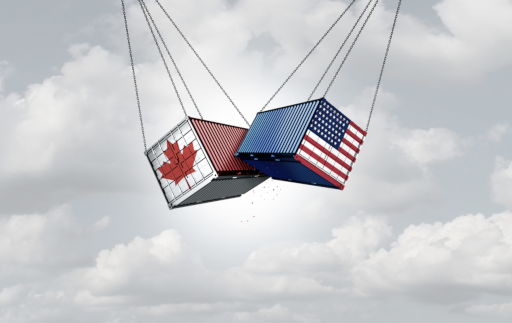
The Business Monitor asked about the impact of tariffs in the last edition of the Business Monitor and found it was more widespread than many analysts were suggesting. In the summer we found that U.S. tariffs were having a strongly negative impact on the financial health of about a quarter of a million businesses.
The Fall Edition explores this issue in more depth – what exactly are the impacts businesses are experiencing from tariffs? The key findings from this show:
- Over 50% more companies have had to cut operating costs and lay off staff than expected to do so in early 2025.
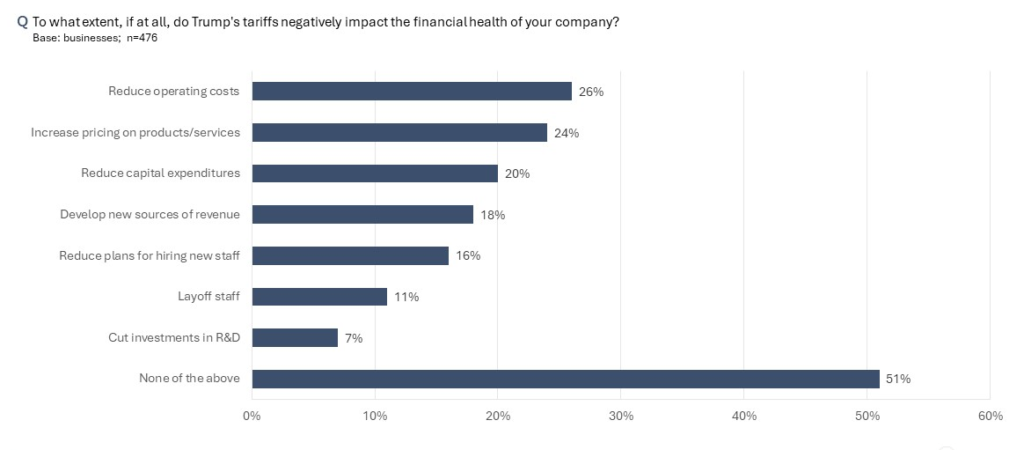
- Almost half of businesses are engaging in cost-cutting measures and/or raising prices in response to the tariffs.
- A quarter of businesses have either reduced operating costs and/or increased their pricing.
- Over 1 in 10 have laid off staff and/or cut back on hiring plans.
- 1 in 5 have cut back on capital expenditures.
- The only industry with a low reading on these impacts is financial services.
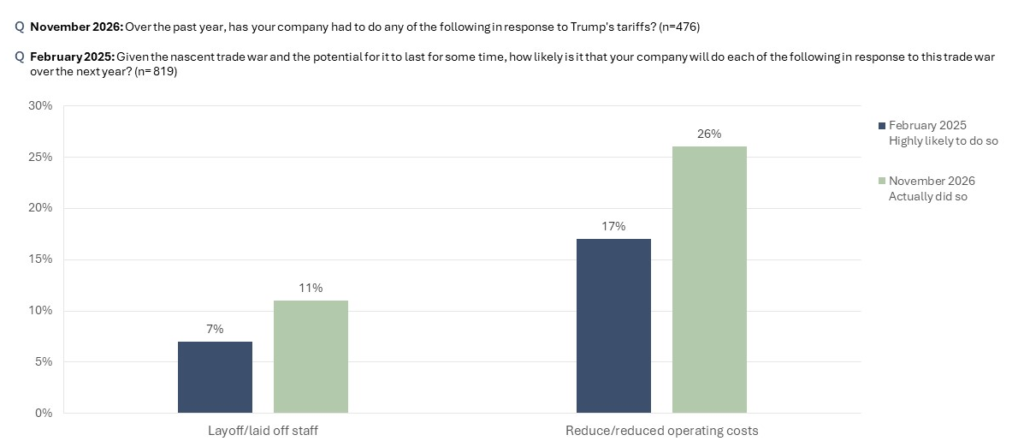
At the start of Trump’s second presidency, The Business Monitor asked business leaders about their expected response to tariffs and the looming trade war. As it turns out, layoffs and cost cutting have been more widespread than expected in early 2025.
A more detailed presentation is in the report.
U.S. tariffs have had a worse impact on Canadian businesses than they expected in early 2025
Significantly more companies cut costs and laid off staff than expected to do so in early 2025.
- Over 50% more companies have had to cut operating costs and layoff staff compared with the number than expected to do so in early 2025.
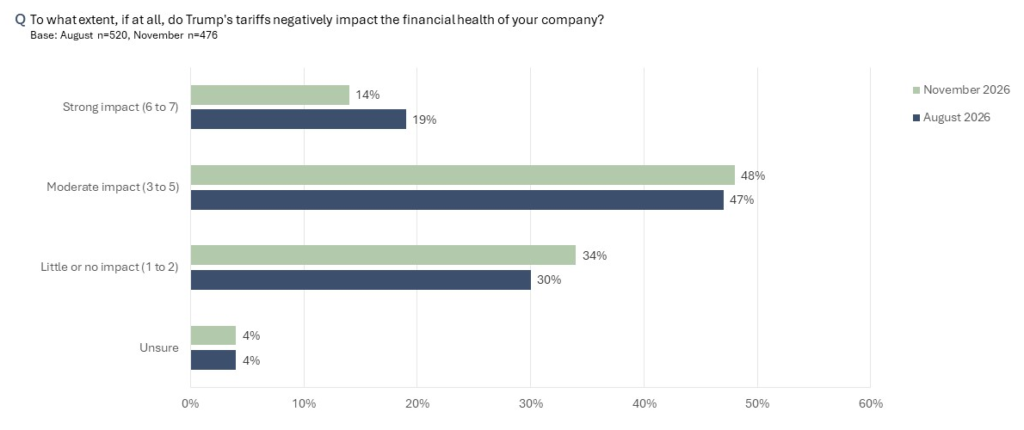
Almost two-thirds of businesses say they have felt a negative impact on their company's financial health
That said, the number saying tariffs are having a strongly negative impact is down 5 points since August.
- This improvement may be the effect of the summer reading occurring at the height of CUSMA negotiations.
- The strongest impact is found in manufacturing, while the least impact is on financial services.
Approximately half of businesses have had to make significant adjustments in response to U.S. tariffs
Large numbers of businesses have engaged in various forms of cost cutting. Roughly a quarter of businesses have increased pricing as well, pointing to the inflationary effect of tariffs.
- The greatest impact has been in manufacturing where almost three quarters have been forced to make adjustments. Financial services shows the lowest impact.
Methodology
The Business Monitor is powered by the Modus Business Panel – Canada’s only purpose-built, fully probability-based business research panel.
The survey was conducted online using both email and SMS invitations/reminders, and completed via desktops, laptops, tablets and mobile devices. A total of 510 responses were gathered from Canadian managers and executives. As Modus Business Panel is 100% recruited using RDD probability-based telephone sampling, it is statistically valid to calculate the margin of error – it is plus or minus 4.3% at a 95% confidence interval. Sample matters.
The survey was conducted from October 30 to November 3, 2026.
The data have been weighted by region and enterprise size using the latest population data from Statistics Canada.
The Business Monitor
The Business Monitor is a quarterly B2B omnibus survey ideally suited for discerning clients who need a cost-effective solution to their business research needs without compromising quality.
The Monitor is powered by the Modus Business Panel – Canada’s only purpose-built and fully probability-based business research panel. It is the gold standard for business research in Canada.